Using Linguistic Geolocation in Forensic Transcription/Translation
By Peter Kashatus
If you want to learn what obsession looks like, look no further than Trevor Rainbolt. A 27-year-old from Arkansas, he first became popular on TikTok when he posted videos of himself playing GeoGuessr: an online geography game where players are shown a random location from Google Maps’ Street View feature, and they try to guess where in the world it’s located. This came after he spent the COVID-19 pandemic in his apartment playing GeoGuessr for up to 12 hours a day. He’s spent so much time playing the game that he knows what a Chilean telephone pole looks like, he can accurately identify license plates in every region of the world, and he can easily tell if the dirt he sees is from Botswana or Brazil.
This is a practice called geolocation: the process of identifying real-world geographic locations by analyzing available data points. Besides TikTokers like Rainbolt, geolocation is used by law enforcement officers and intelligence analysts to identify specific locations with limited, and sometimes contradicting information. In Forensic Transcription/Translation (FTT), audiovisual linguists use linguistic geolocation: the process of identifying real-world geographic locations by analyzing linguistic data points within a recorded statement or text. While the data Trevor Rainbolt uses is what he sees (like license plates and telephone poles), the data in linguistic geolocation is what we hear.
Why is Linguistic Geolocation Important for FTT?
The job of a Forensic Transcription/Translation Specialist (FTTS) is to produce a bilingual transcript that will serve as the primary lens through which the prosecutor, the defense counsel, and the jury view the facts of a court case. As cited in the 2012 edition of Fundamentals of Court Interpretation, it must answer fundamental questions about what is said in the recording: “Who did what, to whom, when, where, why, and how?” (Page 1009) Linguistic geolocation is the process of answering the fundamental question of “where.”
To someone who doesn’t work in FTT, this might sound like an easy job. After all, if a Spanish-speaking suspect of a crime is giving their alibi and says, “Yo estuve en la quinta,” (literally, “I was on the fifth”), any reasonable linguist would translate that to “I was on 5th Street.” Right?
But what if they meant that they were in La Quinta Inn, which is on 8th Street?
Linguistic geolocation can also help make unintelligible words intelligible. If a Spanish-speaking person identifies a business or street name in English, but their foreign accent renders their utterance ‘semi-intelligible,’ an FTTS can use context clues from elsewhere in the recording to help them figure out what the person said.
There are several other ways a linguist can help fill in the geographic gaps of a transcript. Below are three scenarios (both fictional and real-world) of Spanish-English FTT transcripts that utilize linguistic geolocation.
Example 1: The 5½ -block error
First, let’s analyze this fictional example. In this scenario, a young male steals the phone of an elderly Puerto Rican man in Manhattan’s East Village on the street and flees the scene. The victim of the crime (noted as “VIC”) is telling the detective (DET) where the crime occurred.
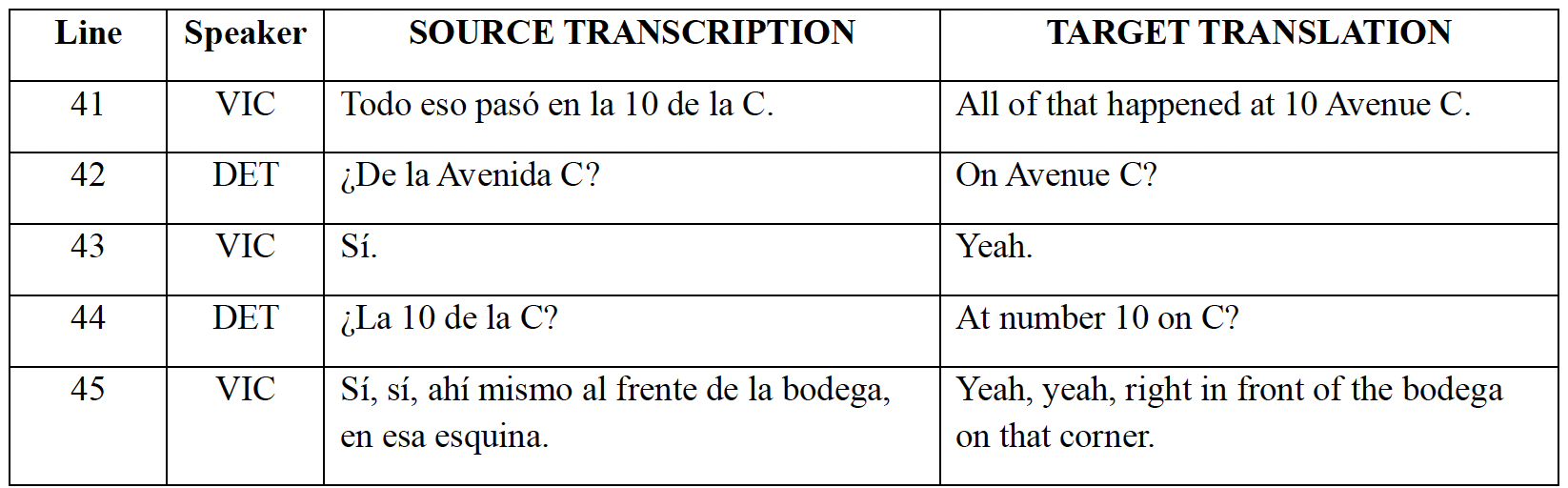
In this case, let’s say the FTTS wants to verify the address. She goes on Google Maps, searches “10 Avenue C,” and she sees that it does exist, between East 4th Street and East 5th Street. (Avenue C in the East Village is also known as “Loisaida Avenue,” and it appears on Google Maps as such.) To take it a step further, she looks for a bodega (a deli) at a street corner, and she finds one at the corner of East 4th Street and Avenue C. Although 10 Avenue C is not on the street corner, she figures there is enough information to verify that that is the correct address.
Everything looks good, right? But later in the transcript, she encounters some more geographic information about the crime:
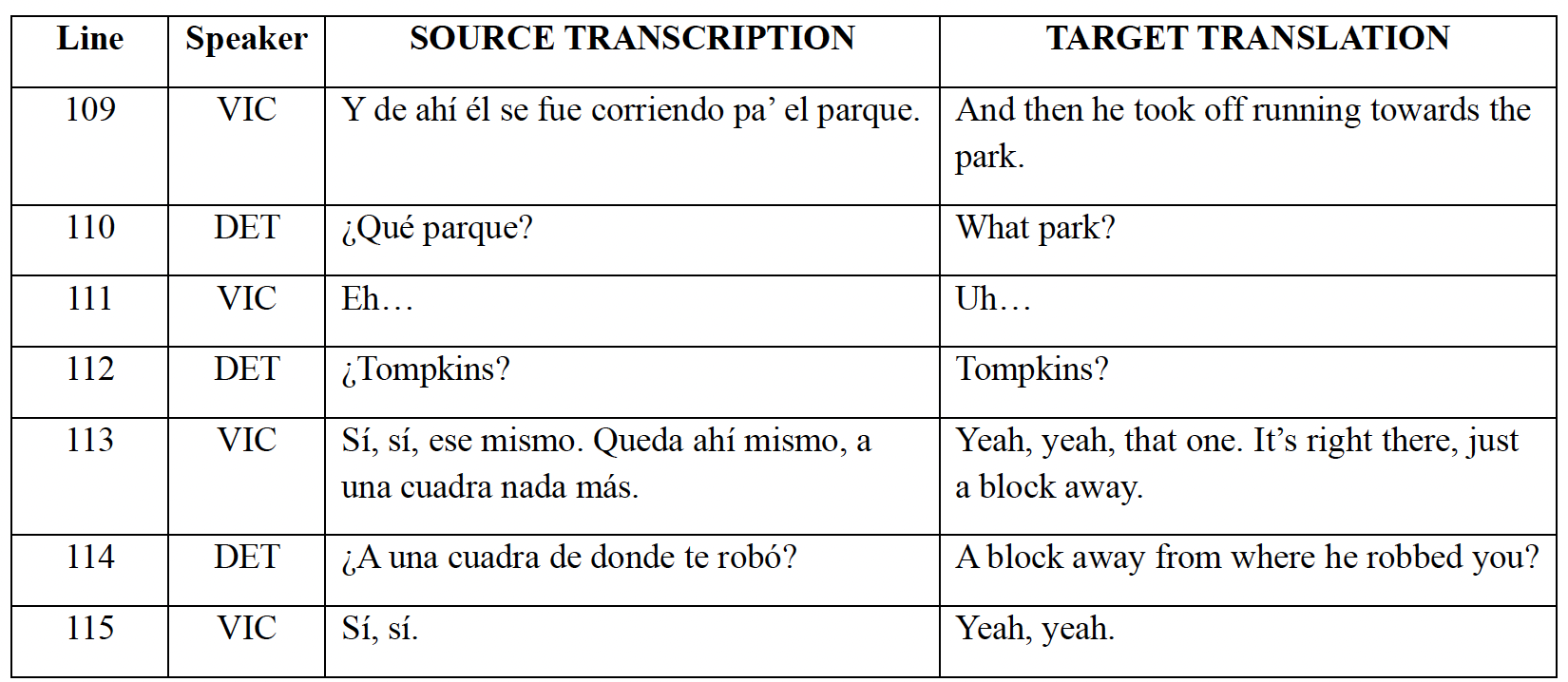
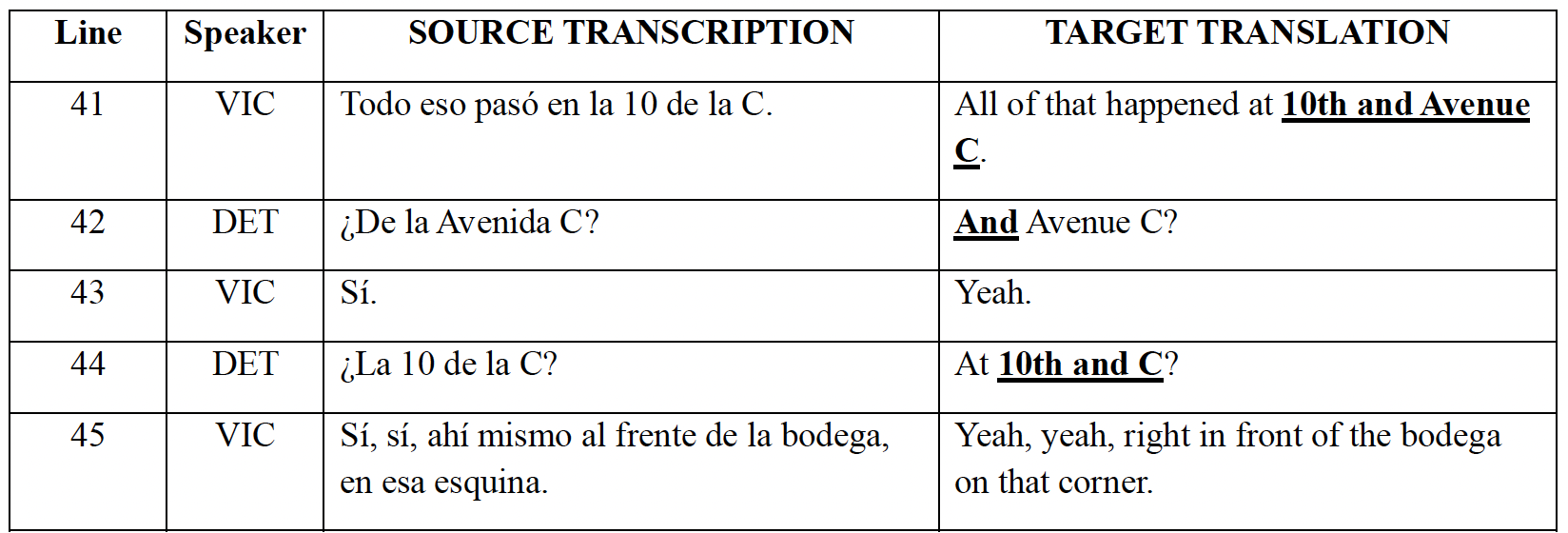
The FTTS returns to Google Maps to verify that the park called “Tompkins” is one block away from 10 Avenue C. Instead, she finds that Tompkins Square Park is actually three blocks away. Upon further inspection, she realizes that “10 de la C” doesn’t mean “10 Avenue C,” but it means “the intersection of 10th Street and Avenue C,” which is 5½ blocks away. She also finds another bodega located at that intersection, which is exactly one block away from the northeast corner of Tompkins Square Park.
This Nuyorican practice of noting intersections with “de la” instead of “y la” is something that I’ve repeatedly seen in my FTT work, specifically in the greater New York City area. Although regional dialect variations like this might not be too obvious to find, further contextual information must always be used to verify what has already been translated.
The FTTS then changes Lines 41-44 to accommodate the correction:
Example 2: Inebriated Intelligibility
Now let’s analyze this real-world example, which can be found on YouTube here. In this scenario, a Spanish-speaking Limited English Proficient (LEP) man is pulled over and questioned by local police regarding his recent whereabouts and alcohol consumption. A bilingual officer (OFM) asks the unidentified male (UM) where he was coming from:
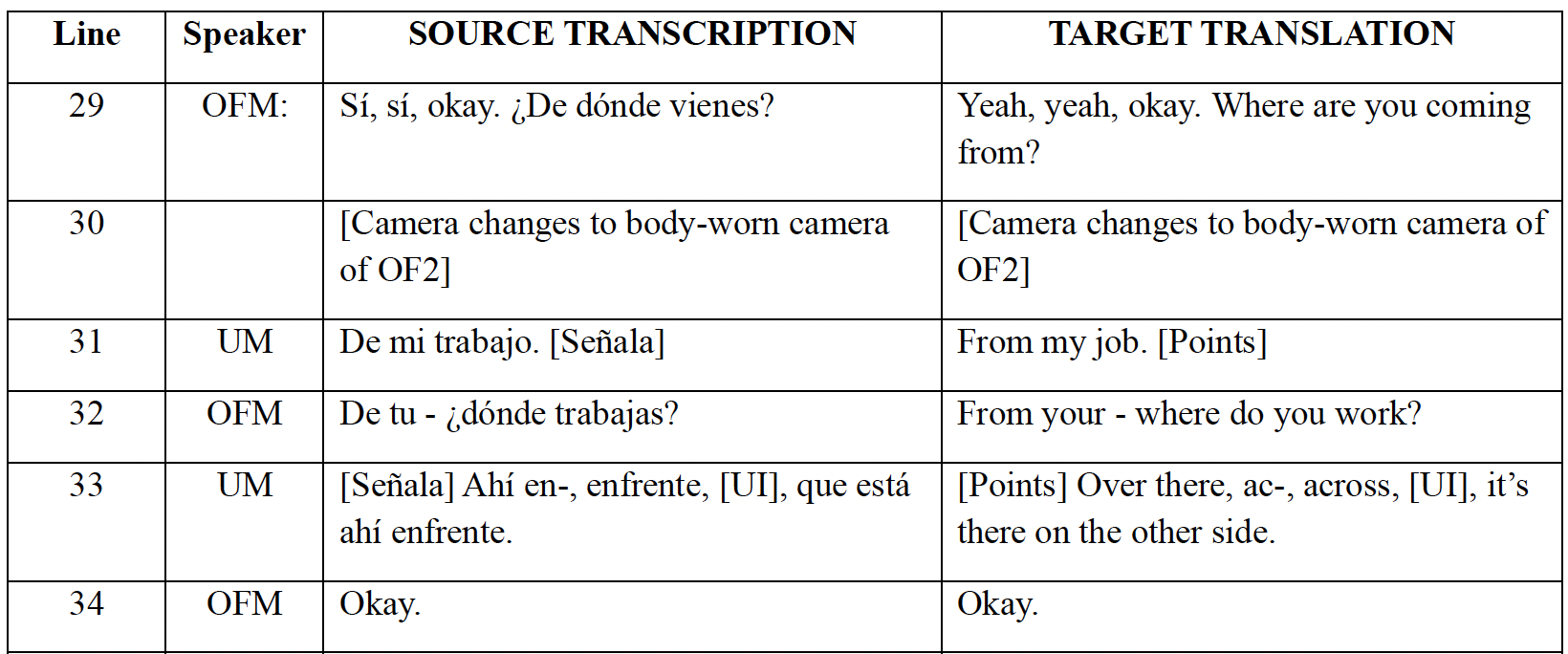
When I first heard this segment, I couldn’t fully distinguish what the man was saying on Line 33, which is why I wrote [UI], signifying his utterance was unintelligible. Given that the utterance was in English and the man had a strong foreign accent (and he was also inebriated), I was only able to ‘half-hear’ what he said. However, over 100 lines later, I found the context I needed:

Since the incident took place in League City, Texas, I then looked up “collision centers league city texas” and found Joe Hudson’s Collision Center. (Joe Hudson’s Collision Center has since been acquired by a separate company, and the location is now known as Gerber Collision & Glass.) This phonetically sounded like what the man was initially saying on Line 33, and I then made the correction. A larger section of the transcript can be found on my website here.
Example 3: Going to the Hospital
Finally, let’s analyze another real-world example, which can be found on YouTube here. In this scenario, a suspect (denoted by his initials, “DVG”) is telling a detective (DET) about his journey transporting a murder victim from the suspect’s house in Hialeah, Florida:
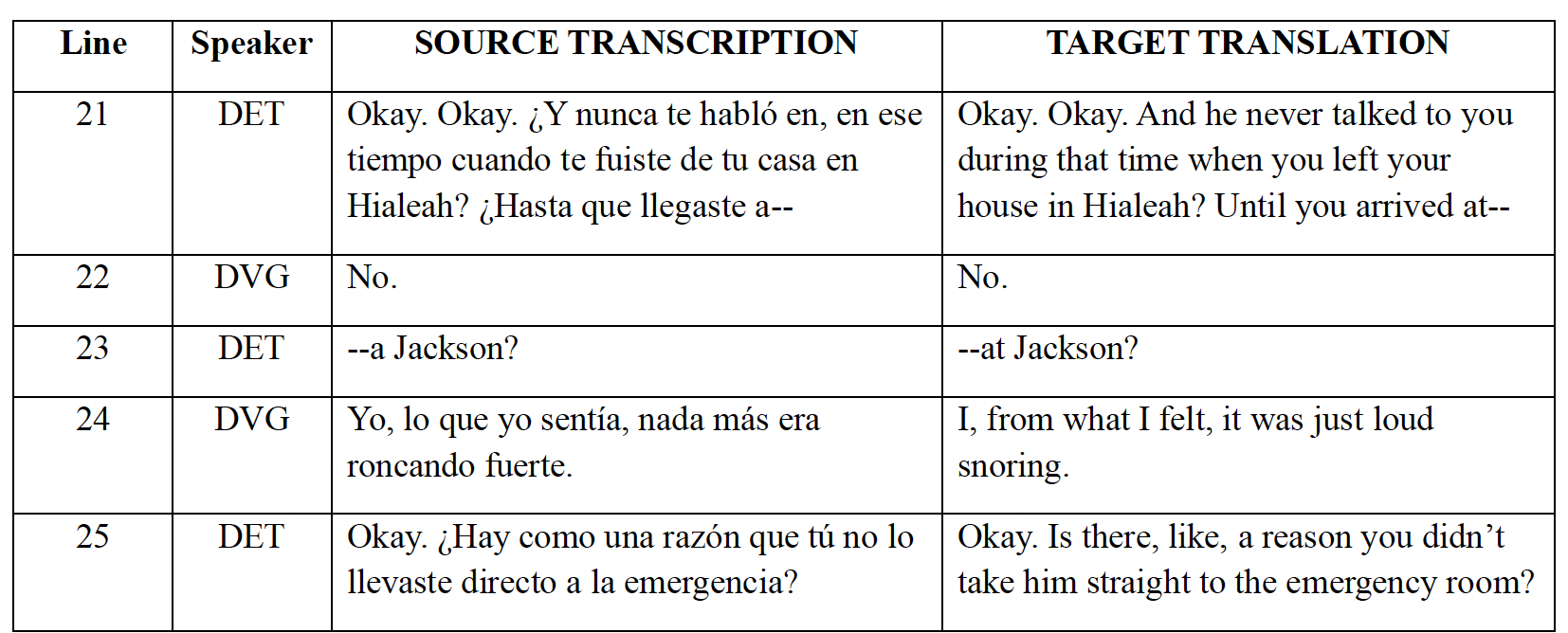
On Line 23, an FTTS might assume that “Jackson” is another person, but contextual clues from earlier in the interrogation showed that the suspect took the victim to a hospital. I searched “hialeah Jackson” on Google and quickly discovered that Jackson Memorial Hospital is a 15-minute drive away. The suspect gave further identifying information at 00:17:54 of the video when he mentions a nearby intersection: 20th Street and 10th Avenue. I then added a translator’s note to the translation column of Line 23:

A larger section of the transcript can be found on my website here.
Best Practices for Linguistic Geolocation
To avoid mistakes and ensure geographic accuracy is upheld, here are a few best practices for an FTTS to use on their transcripts.
Verify every address that is uttered
o This can give geographic context to where a crime took place, a suspect’s route to/from a crime scene, or it can give linguistic context to how the speaker utters street addresses.
Consistently use context clues to verify your translations
o As shown in the examples above, geographic context can prove or disprove the veracity of your translations. It never hurts to do one more search on Google Maps to cross-reference all of the addresses and locations you have.
Keep a record of your research
o If an FTTS used Google Maps or a certain Google search term to research or verify an utterance or address, it would help immensely to keep that information on hand as you continue working on the transcript. Fundamentals notes that this would be an indispensable tool for the FTTS if they are called to defend the transcript in court. (Page 1021)
Conclusion
Whether we are identifying a Chilean telephone pole or a Nuyorican preposition, the goal is always the same: Precision. The job of a Forensic Transcription/Translation Specialist is to ensure that the “where” of a case is never left to chance. As we’ve seen, a single misunderstood phrase like “de la” can move a crime scene 5.5 blocks away from its actual location.
Just as Trevor Rainbolt uses visual cues to find a road in a random photo an FTTS uses linguistic cues to find the truth in a recording. We aren't just translating words; we are anchoring the facts to a physical coordinate. Because in the world of forensics, if you get the “where” wrong, the rest of the case might follow.