A Guide to Nonverbal Notations in Forensic Transcription/Translation (FTT)
By Peter Kashatus
In Quentin Tarantino’s 2009 World War II film Inglourious Basterds, there is a pivotal scene where British Army Lieutenant Hicox (played by Michael Fassbender) goes undercover as a Captain in the German SS. He enters a bar in German-occupied France, and although suspicions arise regarding his slight foreign accent, he manages to convince a Gestapo officer that he is indeed German. His cover is blown, however, when he orders three glasses of beer by lifting up three fingers: his index, middle, and ring fingers. Unbeknownst to him, Germans count by beginning with their thumb - not their index finger.
If this scene was analyzed in accordance with the practices of Forensic Transcription/Translation (FTT), all the German words would have to be recorded and translated. But not only that – the nonverbal actions would have to be recorded as well. In this scene, those would be the laughing, the pauses, the background conversation, and – last but definitely not least – Lieutenant Hicox’s fatal translation error.
But how should such an error be represented in a transcript? Below is a sample FTT transcript of the dialogue in question. The characters are Lieutenant Hicox, Major Hellstrom (the Gestapo officer), Eric (the bartender), and Bridget von Hammersmark (a German spying for the British). You can watch the conversation using this link and skipping to 10:20 in the video. The error is on Line 9.
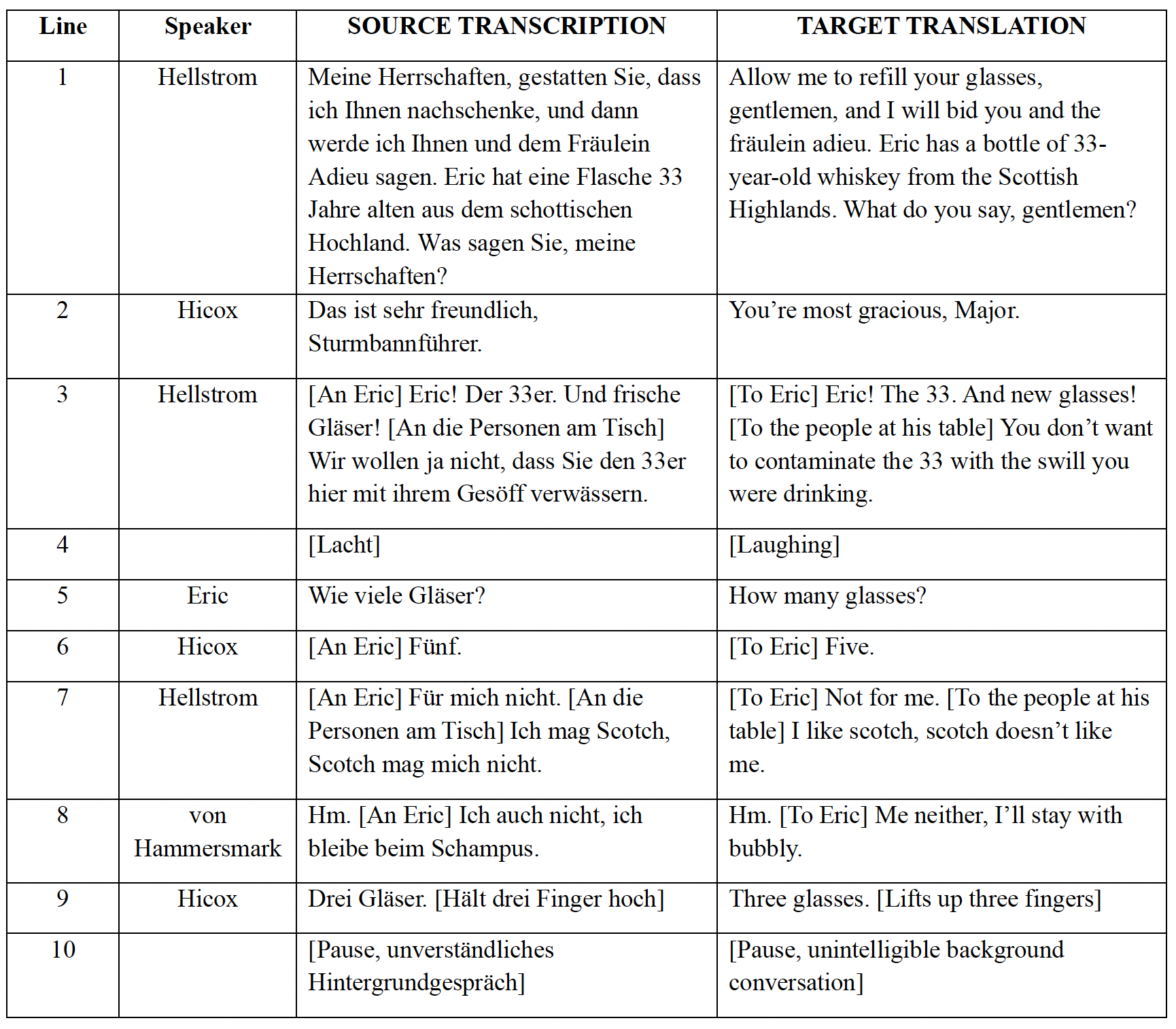
While this transcript is mostly accurate, Line 9 does not adequately “translate” the nonverbal gesture. The reader would have no idea that Lieutenant Hicox made a mistake, let alone that his cover was blown. To better understand how to write nonverbal notations like this, continue reading to the end.
Best Practices for Using Nonverbal Notations
In my experience, nonverbal notations are usually written in brackets “[]” or parentheses “()”. I am not aware of any other ways to punctuate a nonverbal notation, but other methods of doing so may exist. In the German-English transcript above, they are written in English as [Laughing], [Lifts up three fingers], and [Pause, unintelligible background conversation].
In its position paper on Forensic Transcription/Translation, the National Association of Judiciary Interpreters and Translators (NAJIT) affirms that gestures and other nonverbal communication should be annotated in the bilingual transcript when they “significantly affect verbal communication.” Furthermore, those descriptions “should be rendered using neutral language and without qualifiers.” Fundamentals of Court Interpretation claims that the transcript “should reflect the verbal and nonverbal aspects of the communication and document all these discourse characteristics in an empirically sound manner.” (Page 992)
These two sources basically say the same thing: Use nonverbal notations when they affect and are relevant to the communication, use neutral language when writing them, and make sure they are supported by evidence (both from the video/audio material, and from other relevant contextual information).
However, these two sources differ slightly on the first point from above: when to use nonverbal notations. Fundamentals argues that an FTT specialist should “document any and all sounds from the [source language] recording (e.g., squeaks, squawks, steps on gravel, doors slamming, music, traffic noises).” (Page 1020) NAJIT, on the other hand, argues in its position paper that “it is unrealistic to expect a written transcription to accurately depict every physical movement a person makes when involved in verbal exchanges with others.”
There is definitely some nuance to take into consideration with this. A five-minute wiretap, for example, will likely have a transcript that is much more “attuned” to all of the background laughter, sighs, and murmurs made by the speakers. These actions will likely have a larger overall impact on the reader’s understanding of the situation. An hour-long statement to police, however, might be different. If the victim of an armed robbery is giving their statement in a hot room and they roll up their sleeves while the detective is writing notes, should that rolling-up-the-sleeves be included in the transcript? If so, then the FTT specialist should also note every time that person taps their foot on the ground, sniffles, crosses their legs, and scratches their ear.
My point is this: The decision on whether or not to write a nonverbal notation relies on the action’s contextual importance to the source material. There is no single “formula” on how to determine if a cough should be noted in the transcript, so that decision is left to the FTT specialist. Specialists with more experience will have a better understanding of when and how to write these notations than those with less experience.
What Are Typical Nonverbal Notations?
While any imaginable action be depicted in a transcript as a nonverbal notation, I have a list below of some of the most frequent ones that I come across in my work. Unlike some of the notations I mentioned above, it is my opinion that all of the notations in the list below should be mentioned in FTT transcripts – no exceptions. I arranged them in four different categories:
1. Pauses
2. Background noises
a. Unintelligible background conversation
b. Unintelligible background radio transmissions
c. Sirens
d. Yelling/Crying
3. Vocal Expressions
a. Laughing
b. Smiling
c. Crying
4. Gestures
a. Nodding/Shaking head
b. Pointing
c. Gesturing to a body part
d. Demonstrating an act
e. Holding up fingers
Pauses
Pauses can come in many forms. They can be only a few seconds, and they can be several minutes. For longer pauses, it is preferable to also write how long the pause was by writing the start and end time of the pause. For example, a 3½ minute pause can be denoted as [Pause from 4:12-7:42].
Background Noises
Unintelligible background conversation is, by far, the most common notation I use. It is less common in video/audio material where there are only two speakers (like statements to police). However, in a video taken from a police officer’s body-worn camera, this notation is far more likely to occur. In my sample transcript from a DWI arrest, [Unintelligible background conversation] is used three times, in a transcript that analyzes just over three minutes of time. And that video only has four speakers – what if it had eight? What if the transcript covered 30 minutes of video? That notation could certainly appear dozens of times in such a scenario.
Unintelligible background radio transmissions are also common in body camera footage. Sirens and yelling/crying in the background also do occur.
Vocal Expressions
Laughing (or chuckling), smiling, and crying are common nonverbal actions that occur in forensic dialogues. In Line 26 of my sample interrogation transcript, the suspect both chuckles and smiles in his response to the detective’s question: “Is there, like, a reason you didn’t take [the victim] straight to the emergency room?” In this scenario, I keep NAJIT’s requirement of neutral language in my notations. I don’t write [Chuckles sarcastically] or [Smiles nervously], since I do not truly know why he is chuckling and smiling. Is he nervous? Is he hiding something from the detective? Did he just think of a funny joke in that moment? All I know is that he chuckled and smiled, and I will let the viewer/reader come to their own conclusion of why he did those two things.
Here is a good rule of thumb I use to make sure I use neutral language: Try not to use adverbs. Stephen King wrote in his memoir On Writing that “the road to hell is paved with adverbs,” and although I do not wish to be as dramatic as him in this regard, I do feel that adverbs often insert unnecessary subjectivity into notations.
Gestures
Nodding/shaking one’s head is another very common nonverbal notation. In Line 6 of my interrogation transcript, I write the notation [Nods head yes] when the suspect confirms the detective’s statement that he had managed to get the victim into his car. Nodding/shaking one’s head can serve as a yes or no response, so these notations must always be included in transcripts of high-stakes footage.
Pointing is another common nonverbal notation. On Lines 31 and 33 of my DWI transcript, the unidentified male [Points] to where he works. I specifically use ambiguous language in my notation, since the viewer cannot see exactly what he is pointing to. Later in that same transcript, the female officer [Points to UM’s car] when identifying the supposed sixth and final beer that the unidentified male drank. I make this notation more specific because I can see the half-drunk beer sitting on top of the unidentified male’s car.
Indicating or gesturing to a body part is another common nonverbal action that occurs in forensic dialogues. When describing someone’s wounds, for example, a witness will often gesture to their own body parts to describe where a victim was hurt. On Line 14 of my interrogation transcript, the suspect [indicates his right arm] after the detective asks him where the gunshot victim was bleeding from. While that notation is quite straightforward, there could be more ambiguity. For example, if the detective’s body blocked the suspect’s arm from the view of the camera, I would not know for sure that the suspect is indicating his arm. In that case, I might write [indicates his right side] instead.
Now, let’s say the victim of an armed robbery was asked to demonstrate how the suspect drew their weapon in a visually recorded police statement. That person would then demonstrate the act. Let’s say they acted as if they had a firearm on their right side, and they drew it and pointed it in front of them with their right hand. I could use a longer notation like the following: [Reaches right hand to his right side, reaches right hand straight out in front of himself]. The reader would know what I am describing, but the reader can also see the video footage themself and come to their own conclusion of what they are seeing. Rather than writing a wordy notation, I could simply write [Demonstrates with his right hand], and the reader will still know what I am describing.
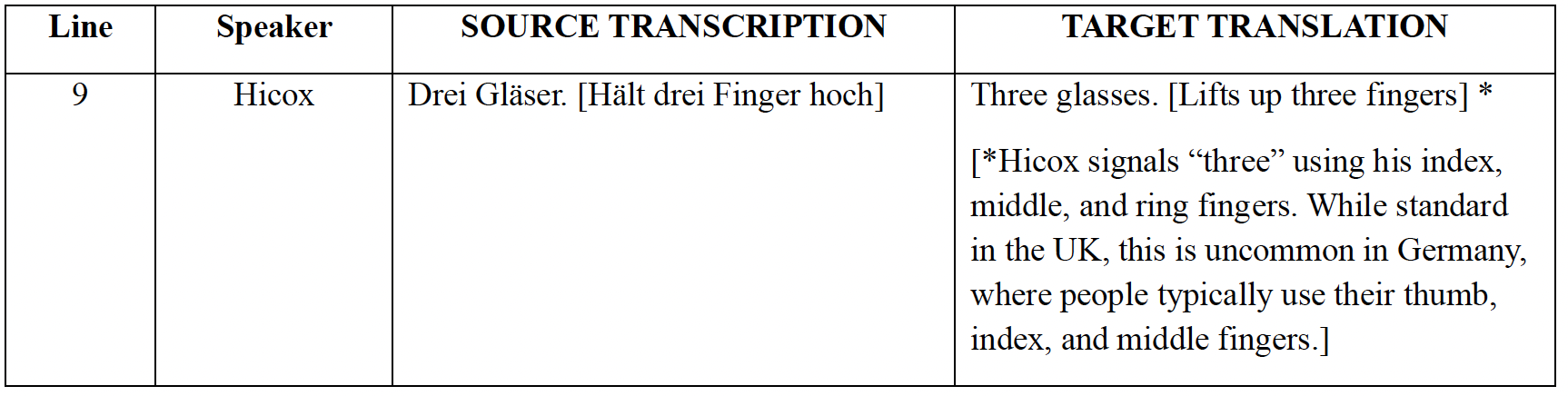
Finally, people sometimes hold up fingers to visually describe a number. While this example is not as dire as the one from Inglourious Basterds, my DWI transcript has several notations of holding up fingers. One important instance is on Line 150 when Unidentified Officer 1 (OF1) [Holds up fingers], but it is unclear how many he holds up. That is because his right hand is off-camera. I can assume that he is holding up seven fingers, but since I cannot see both of his hands, I simply write [Holds up fingers].
When to Use a Translator’s Note
Fundamentals states that best practice for using translator’s notes is to “clarify the translation of a particular word choice or expression.” (Page 1034) However, they should only be used when necessary, and they should be concisely written. Their main role is to make the foreign-language content “more transparent and accessible to monolingual consumers of the FTT product by providing necessary linguistic and cultural clarification.” (Page 1034)
In my opinion, the perfect example for this can be found at the very beginning of this paper. When Lieutenant Hicox holds up three fingers in the typical British manner (index finger, middle finger, and ring finger), the FTT Specialist must “translate” that error to an English-speaking reader. This cannot be represented in the transcription column, nor in the direct translation. That is why, in my revision for Line 9 from the above transcript segment, I use a translator’s note. You can see my revision below:
Conclusion
In the high-stakes world of forensic evidence, a transcript that only captures spoken words is often only telling half the story. As the Inglourious Basterds example vividly illustrates, a single "untranslated" gesture can carry more weight — and lead to more significant consequences — than an entire conversation.
Ultimately, the decision of what to include relies on the specialist’s understanding of the action’s contextual importance. Whether it is a subtle nod, an ambiguous point, or a culturally specific “tell,” the responsibility of an FTT Specialist is to provide the linguistic and cultural clarification necessary to make the foreign-language content transparent to the reader. By documenting these discourse characteristics in an empirically sound manner, they ensure that the silent parts of the conversation speak as clearly as the words themselves.